Is Seismology Interesting?
When observational data betrays our "common sense"
Earthquakes are often thought to be well-understood phenomena. However, when we carefully trace the observational data, we find that earthquakes are far more diverse, complex, and sometimes highly irregular than we imagine. Here, we hope to convey the fascination of seismological research as we follow two specific "mysteries" revealed by data.
Chapter 1: The Mystery of the M9 Kamchatka Earthquake that Recurred After 73 Years
Chapter 2: The Mystery of Stronger Shaking in the Opposite Direction of the Rupture
Chapter 1: The Mystery of the M9 Kamchatka Earthquake that Recurred After 73 Years
M9-class megathrust earthquakes have traditionally been thought to occur once every few centuries, releasing massive amounts of accumulated strain. However, in the summer of 2025, an M9-class earthquake struck off the coast of Kamchatka, in the exact same location where another M9 had occurred just 73 years earlier.
Did it rupture the exact same area again?
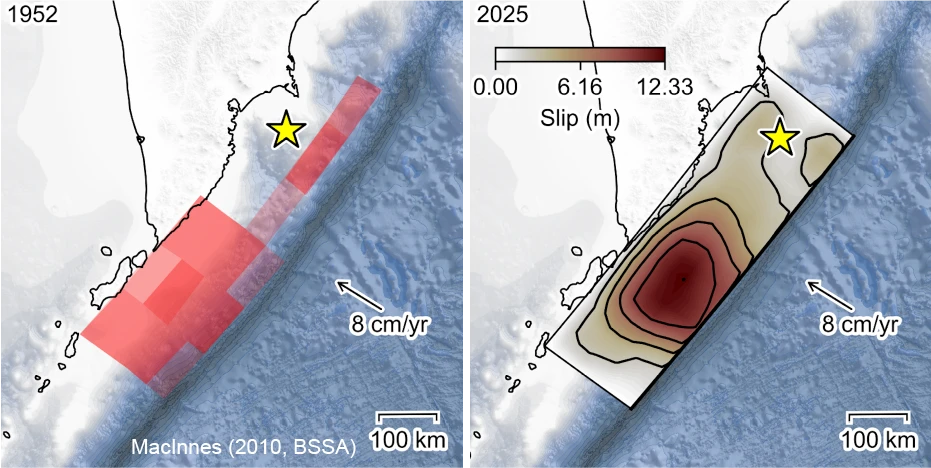
The observational data tells us that "a similar megathrust earthquake repeated."
But why did a megathrust earthquake repeat in such a short interval of just 73 years?
A strange double acceleration?
Are strange earthquakes occurring?
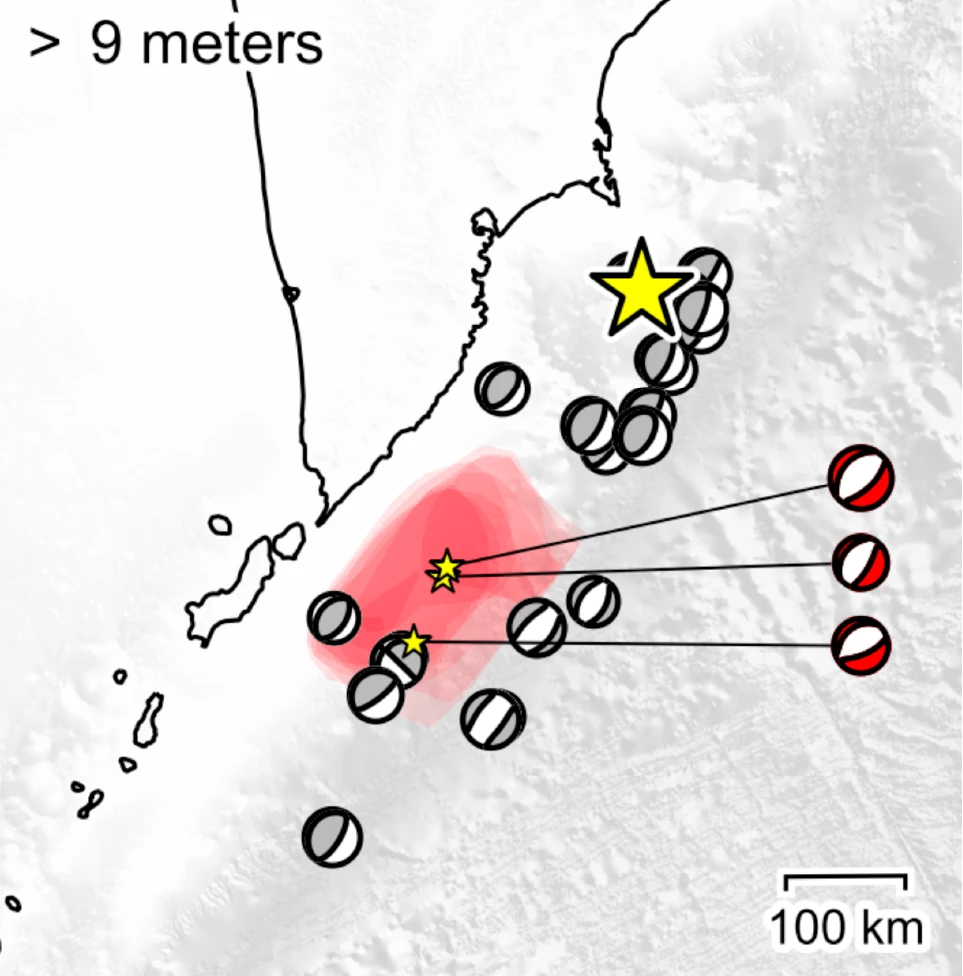
An overshoot (excessive slip) occurred during the 2025 Kamchatka megathrust earthquake.
The strain released by a megathrust earthquake is not constant. Sometimes the slip is insufficient, and sometimes it is excessive. We are observing behavior that simply cannot be explained by a basic periodic model.
(Terminology Note) Undershoot: Insufficient slip / Overshoot: Excessive slip
Chapter 2: The Mystery of Stronger Shaking in the Opposite Direction of the Rupture
Due to the Doppler effect, the amplitude of a sound wave becomes larger in the direction a source approaches, and smaller in the direction it moves away.
Similarly, with earthquakes, ground motion increases in the direction the rupture approaches and decreases in the direction it recedes.
In 2025, a major earthquake occurred in Myanmar.
Did the main rupture propagate south?
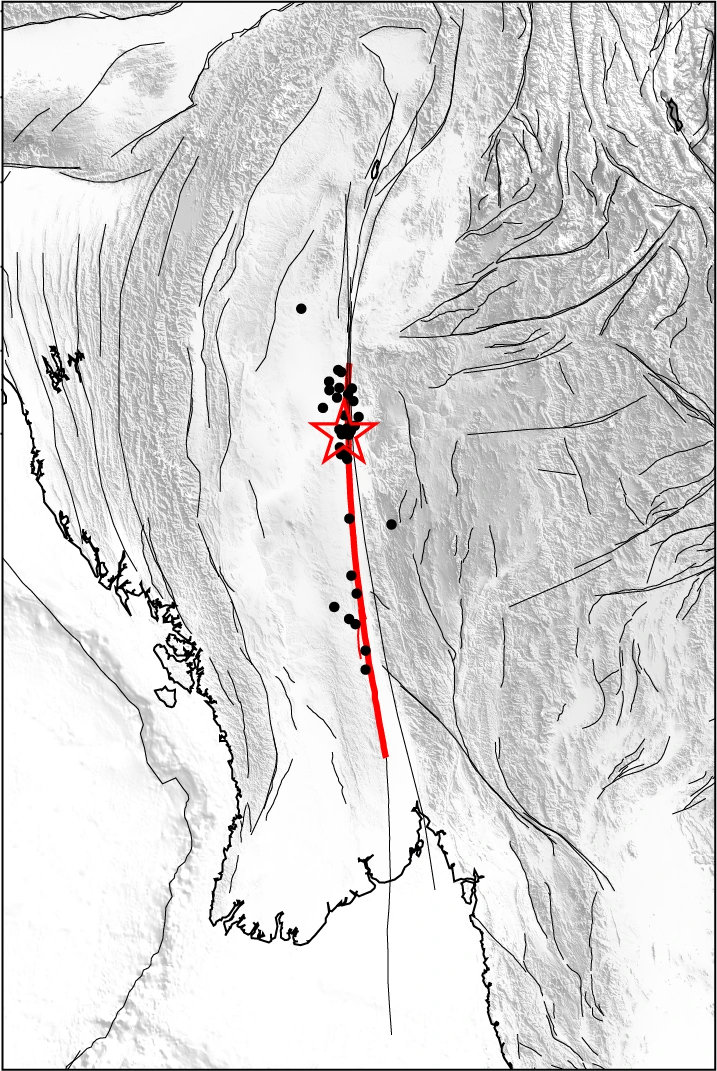
From the aftershock distribution and InSAR data, the rupture appears to have progressed southward.
If the rupture moved south, the shaking to the south should logically be stronger.
However, when looking at the actual seismic waveforms, this expectation is completely overturned.
Does explaining the waveforms require northward rupture propagation?
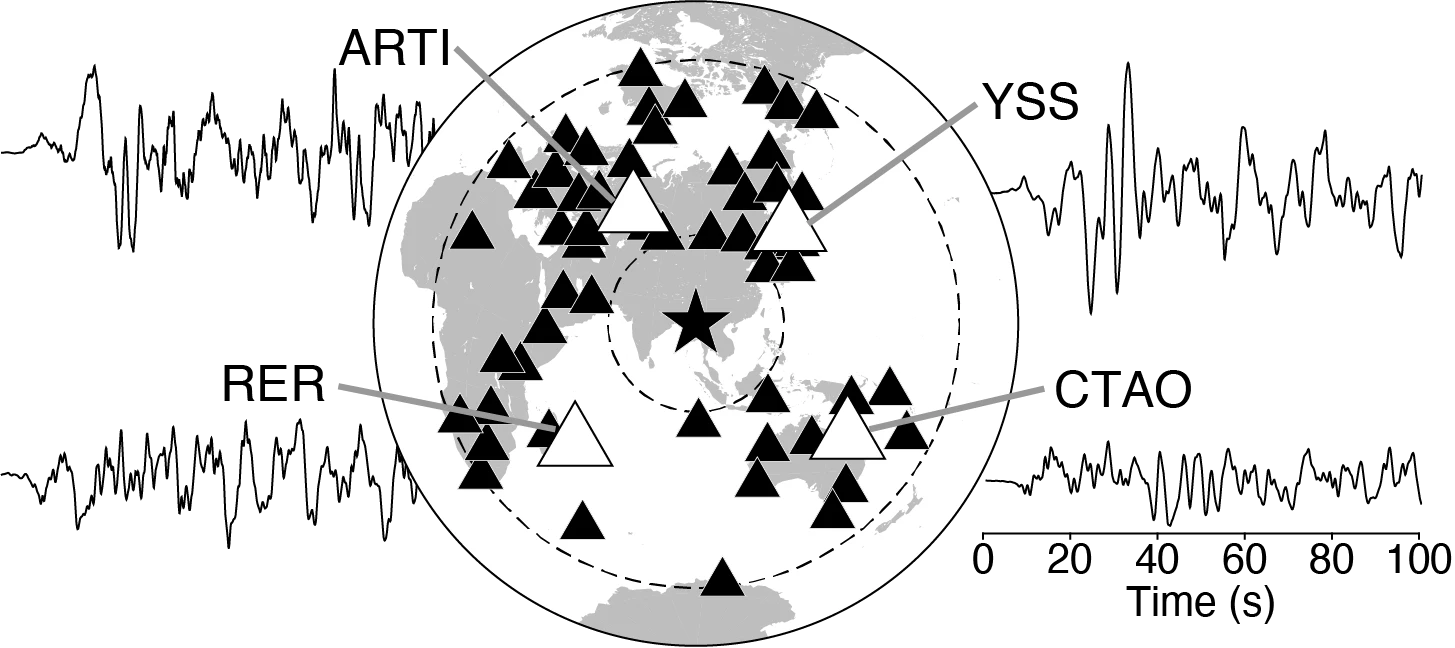
When checking the observational waveforms worldwide, the amplitudes at observation points to the north were larger.
So why do the results from aftershocks and InSAR contradict the characteristics of the observed seismic waveforms?
Is backward rupture propagation occurring?
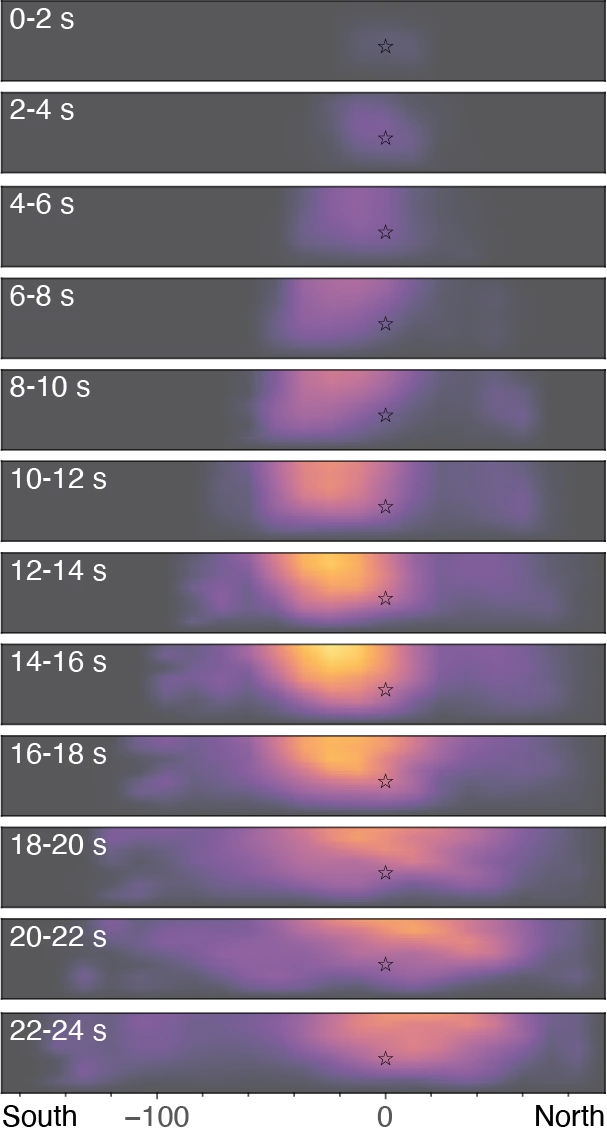
It was revealed that the rupture, after initially proceeding south, propagated backward to the north at ultra-high speed, much like a "boomerang".
The true nature of earthquakes told by observational data is far more complex and diverse than our "common sense."
Armed with the latest analytical methods, we solve unsolved mysteries and surprise the world.
This intellectual adventure is precisely the thrill of seismology.
Properly understanding earthquakes ultimately leads to better disaster prevention and mitigation for society.
To see how we acquired this "new method", explore our development story.
Yagi et al. (2025) . Breaking the Cycle: Short Recurrence and Overshoot of an M9-class Kamchatka Earthquake. Seismica, 4(2). doi:10.26443/seismica.v4i2.2012
Inoue, Yamaguchi, Yagi, et al. (2025). A multiple asymmetric bilateral rupture sequence derived from the peculiar tele-seismic P-waves of the 2025 Mandalay, Myanmar earthquake. Seismica, 4(1). doi:10.26443/seismica.v4i1.1691