Challenge Common Sense.
Are the Underlying Assumptions Correct?
Developing the power to reframe questions in the AI era
In an era where AI provides "plausible" answers, what knowledge and skills should a university provide?
While you can certainly learn seismology and cutting-edge data analysis skills here,
What you truly need to acquire is the ability to reframe questions and the capacity for flexible, resilient thinking.
Nurturing the Power of Inquiry over Rote Answers
Although we are a seismology lab, our educational goal transcends simple knowledge acquisition. We aim to help students gain "flexible thinking skills to adapt to any situation" that will serve as a weapon throughout their careers.
A "Sensor for Inconsistency" in the AI Era
AI possesses vast knowledge and can provide "answers" if given a good prompt. However, those answers are determined almost entirely by how the "question" was framed. In the Yagi Lab, we train ourselves to notice inconsistencies—asking, "Is the premise wrong?" or "Would a different condition yield a completely different answer?"—and to formulate new inquiries.
No One Starts Perfect
"Formulating questions" might sound like a high hurdle. But don't worry. Most of our members started from a point where they "didn't even know what they didn't know." The Yagi Lab is a place where we enjoy the process of organizing those unknowns and transforming them into your own unique inquiries together with faculty.
"Failure" is a Signal that Research is Moving Forward
Hitting a wall is a natural part of research. At the Yagi Lab, we believe that hitting a wall is where the true starting line begins.
Failure as the Key to Discovery: For our first student-led paper, Suzuki & Yagi (2011, GRL), we initially proceeded under the assumption that "the rupture propagation speed of deep-focus earthquakes is determined by the slab temperature."
Just before the senior thesis presentation, we realized this assumption was incorrect. It seemed desperate, but by revisiting the premises together, we shifted the focus from "temperature" to "source depth." This led to the discovery of a new fact: ultra-high-speed ruptures occur specifically at certain depths.
All You Need is Curiosity
The student in this episode didn't have the answer from the start. Rather, it was because they struggled, hit a wall, and grappled with the problem alongside faculty that they reached this discovery. All you need is a bit of curiosity to find the results in front of you interesting.
Unexpected Results are Opportunities
When unexpected results appear, those with less experience often feel despair. Most labs avoid anything that falls outside existing frameworks. We are a bit different; we view the unexpected as "the moment common sense is shattered" and enjoy building new frameworks. To me, the unexpected is one of my favorite "delicacies."
When choosing a lab, if you sharpen your "sensor for inconsistency," you will clearly see whether a lab is clinging to frameworks or not through conversations with faculty and students. Use this as a guide to find the environment that fits you best.
Inconsistency as the Starting Point: Diverse Themes & Environment
Themes are determined based on the student's own interests and "Why?" rather than predefined projects.
- Re-evaluating Megathrust Earthquake Cycles: Questioning whether the "periodic theory" is truly correct.
- Supershear Rupture Incidence: Are ultra-high-speed ruptures rare or commonplace?
- Analytical Method Development: Finding peculiar phenomena previously overlooked using new methods.
Environment Supporting Research
Hardware: Each student is provided with a dedicated terminal (e.g., iMac) and access to large-scale computing servers.
Knowledge Sharing: Analysis know-how and code are managed via GitHub. Access insights from past graduates anytime.
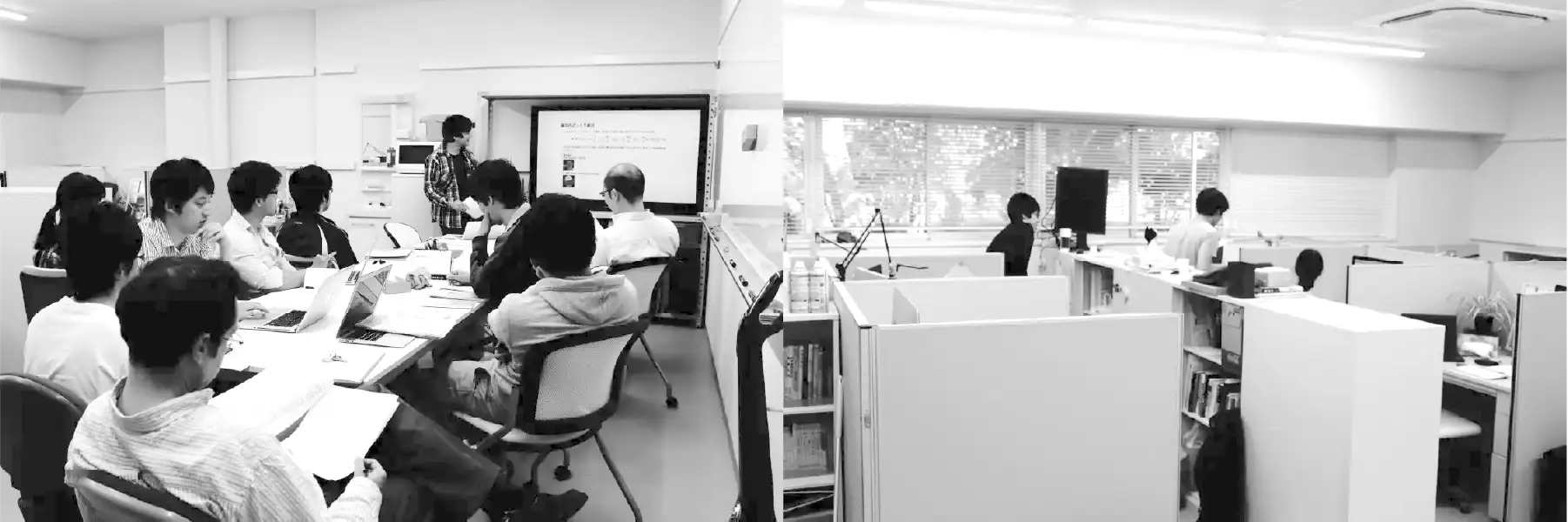
Open Discussion: The lab is equipped with whiteboards and large displays. A culture where students of all levels consult each other daily.
Flat Hierarchy: A culture where everyone uses "-san" for one another. We are partners in research, not just "professor and student."
World-Class Results and Beyond
Our stance of "creating new dots" rather than following trends, combined with the process of "reframing questions and careful verification," results in high-impact achievements.
20% are Top 10% Papers. Impacting the world through unique inquiries and small-team discussions.
24 Student-Led Papers. A culture where students take the lead all the way to publication.
Not Just Academia. Graduates excel in IT, energy, government, and beyond.
Globally Recognized Research Power
20% of our published papers are selected as "Top 10% highly cited papers" worldwide. Many of these are led by the Yagi Lab. This is a testament to the international value placed on the "unique inquiries" we hold dear.
These achievements are often reached by small teams. We intentionally prioritize "individual thinking" and "face-to-face discussion" over massive projects. You can see how unique (or perhaps, endangered?) the Yagi Lab is in its ability to impact the world from a small-scale setting.
Student-Driven Culture
Our students have authored 24 first-author papers, most of which are in top-tier international journals (Q1). They have also received numerous prestigious awards. List of Awards
Diverse Career Paths
Our graduates utilize their "thinking power" across various fields, including IT, energy industries, and the civil service, in addition to academic research. List of Careers
Reading List
It is vital to continuously update the "thinking system" we use to reframe questions. Here are books that have influenced me and that I want students to read with a "sensor for inconsistency." As an unconventional seismologist, my recommendations are, naturally, not about seismology.
Sync: How Order Emerges from Chaos in the Universe, Nature, and Daily Life by Steven Strogatz
Gave me the perspective to view megathrust earthquakes not as isolated faults, but as part of an interacting complex network.
Everything Is Obvious: How Common Sense Fails Us by Duncan J. Watts
Teaches the danger of hindsight bias and serves as a reminder to avoid simplistic thinking when interpreting data and results.
The Black Swan: The Impact of the Highly Improbable by Nassim Nicholas Taleb
Megathrust earthquakes like the 2011 event define the world. It emphasizes the importance of staring directly at decisive "events" even if they are statistical "exceptions."
The Structure of Scientific Revolutions by Thomas S. Kuhn
Explains why flawed old models persist. A motivation for creating the "new dots" that lead to paradigm shifts.
Risk: The Science and Politics of Fear by Dan Gardner
Examines why people fear non-existent risks while overlooking true ones. A reference for connecting seismology to "safety."
Thinking, Fast and Slow by Daniel Kahneman
A guide to avoiding intuitive "fast thinking" in favor of "slow thinking" that doesn't ignore inconsistencies. Essential "etiquette for the brain" for researchers, which I believe is even more valuable in the AI era.